

Before you sink a post or clamp a pole in the ground, the single biggest factor in whether a squirrel baffle will work isn’t the baffle itself, it’s where the whole feeder setup sits relative to trees, fences, and rooflines nearby. A baffle stops squirrels from climbing up from below. It does nothing to stop a squirrel from launching sideways from a branch or fence rail and landing past it entirely. This guide covers how to plan feeder placement at the distance stage, before installation, so you’re not troubleshooting a jumping problem later.
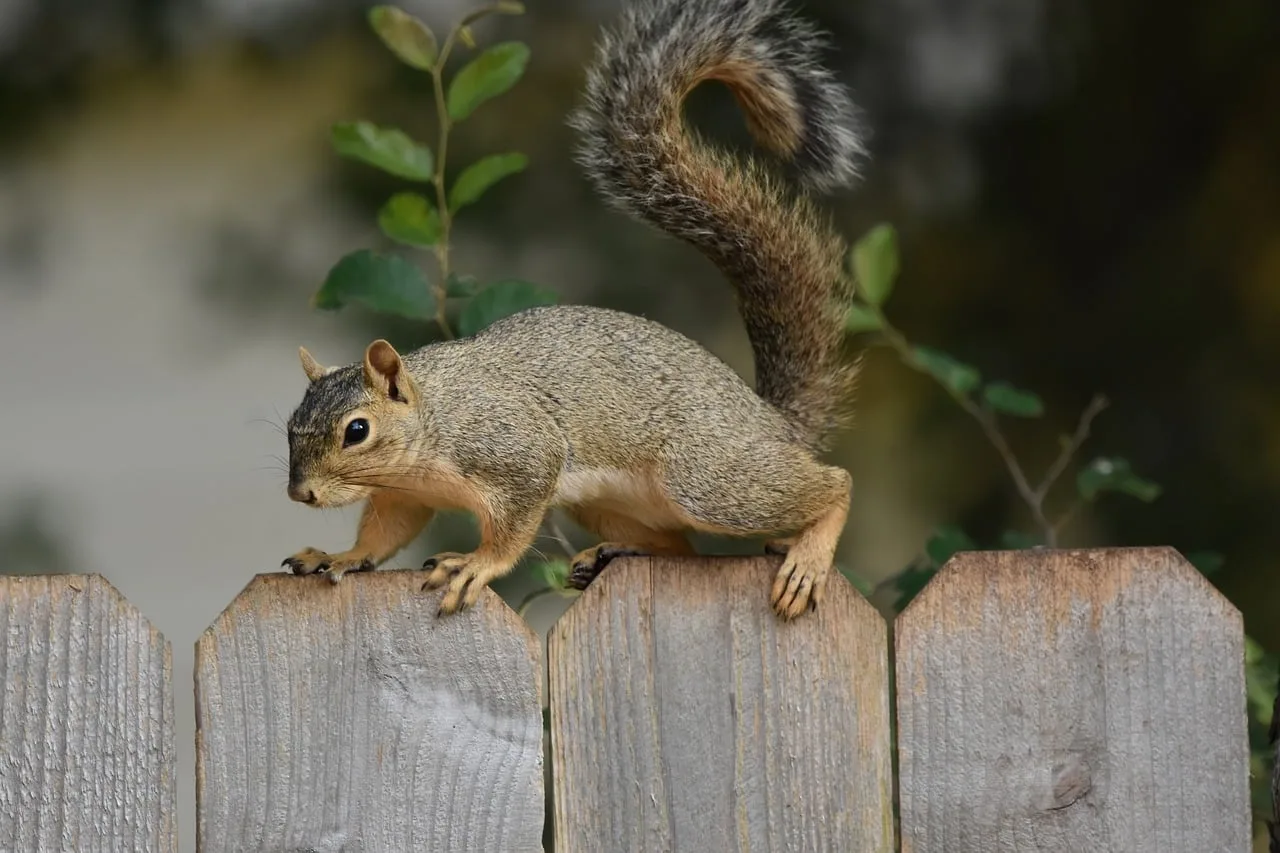
Why Distance Matters More Than People Expect
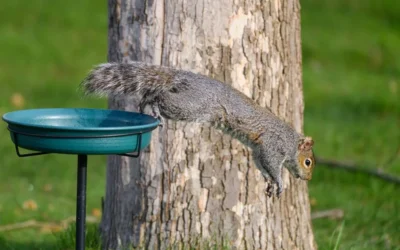
A squirrel doesn’t need to touch the pole to get past a baffle. Squirrels are confident, accurate jumpers, and a nearby branch, fence top, or roof edge can serve as a launch point that skips the baffle entirely. Distance from those launch points does the sideways work that a baffle’s height and shape can’t.
This is a separate problem from baffle height, which is about blocking a climb from ground level. See our guide on how high a baffle should be mounted if height is what you’re deciding on next.
What Counts as a Launch Point
Any solid, stable surface a squirrel can stand on before jumping counts as a launch point. That includes tree branches and trunks, fence rails and posts, deck railings, roof eaves and gutters, retaining walls, and even tall shrubs once they’re dense enough to hold weight.
Walk your yard and mentally mark every one of these near your planned feeder location before you dig a hole or mount a pole bracket. It’s much easier to move a planned location a few feet than to relocate an installed post later.
How to Measure Distance Before You Commit
A simple tape measure or a long piece of string is enough to check distance from a proposed post location to the nearest launch points in every direction, not just the ones facing the yard’s open space. Stand at the exact spot the pole will go and measure outward toward each branch, fence line, or wall.
Account for growth, not just current distance. A young tree or a newly planted shrub will close the gap over a few seasons, so leaving extra room now avoids relocating the whole setup in a year or two. Deciduous trees also change shape with the seasons, and a branch that seems too thin to hold weight in early spring can thicken considerably by summer.
General Distance Guidelines
Wildlife extension resources generally recommend keeping feeders a good distance, several feet at minimum, from the nearest launch point in every direction, not just horizontally. A branch a few feet directly above the feeder is just as much a problem as one several feet to the side, since squirrels jump down onto feeders as readily as they jump across to them.
Treat these as a starting point, not a guarantee. Individual squirrels vary, and a determined animal will push past what a guideline assumes. For a full breakdown of jump distance itself, including how height and angle change the numbers, see our guide on how far a squirrel can actually jump.
Distance by Structure Type
Trees and Overhanging Branches
Trees are the most common launch point, and the one people most often underestimate, since a branch doesn’t have to be directly overhead to matter. Look up and out in every direction, not just straight above the feeder location.
If a mature tree is close enough that trimming isn’t realistic, it’s often easier to move the feeder location than to keep fighting canopy growth every season.
Fences and Deck Railings
A fence top or deck rail is a flat, stable surface, exactly what a squirrel wants for a launch point. These are also usually a fixed part of the yard that can’t be trimmed back like a branch, so distance from the feeder location is the only real lever available.
Roofs and Gutters
A downward jump from a roof edge covers more ground than a level jump from a fence, since gravity adds to the squirrel’s reach. Feeders mounted close to the house under an eave line are one of the most common setups where a baffle alone still fails.
Shrubs and Garden Structures
Shrubs are easy to overlook because they seem soft compared to a branch or fence rail, but a dense, established shrub can hold a squirrel’s weight just fine. Trellises, arbors, and tall garden stakes carry the same risk if they sit close to the feeder.
When You Can’t Get Full Distance
Small yards don’t always have room for ideal clearance in every direction. When distance alone can’t fully solve the problem, a larger-diameter baffle adds a partial buffer by making the final approach harder even from a closer launch point. Our heavy-duty baffle roundup covers oversized options built for exactly this kind of constrained setup.
Combining a wider baffle with the best distance you can manage will outperform either fix on its own.
Plan the Whole Setup Before You Install
Distance planning belongs at the very start, before you choose a baffle or dig a post hole. Once you’ve settled on a location with reasonable clearance, our complete guide to squirrel baffles and installation walkthrough cover the rest of the setup, including baffle height and mount type.
If you’ve already installed a feeder and squirrels are getting past it, that’s a different problem than initial placement. Our guide on stopping squirrels from jumping over a baffle walks through fixes for an existing setup.
Frequently Asked Questions
How far from a tree should a bird feeder be?
Keep the feeder well clear of any branch a squirrel could use as a launch point, in every direction including overhead. There’s no single number that fits every yard, since branch height, angle, and the squirrel’s confidence all factor in, but more distance is always safer than less.
Does a taller baffle make up for less distance from trees?
Not directly. Baffle height blocks a climb from the ground, while distance from trees blocks a sideways or downward jump. A tall baffle on a pole that’s too close to a tree still leaves the jump path open.
What if my yard is too small to get enough distance from every structure?
Prioritize the closest and most direct launch points first, then use a larger-diameter baffle to add a buffer for what distance alone can’t cover. See our metal vs plastic comparison if durability against repeated attempts is also a concern in a tight setup.
Do squirrels prefer jumping down onto a feeder or jumping across to it?
Both happen regularly, and a downward jump from a higher launch point like a roofline generally covers more distance than a level jump from a fence rail. Check clearance above the feeder as carefully as clearance to the sides.
Should I trim branches instead of moving the feeder?
Trimming can work, but it’s an ongoing task rather than a one-time fix, since branches regrow and new growth can restore a launch point within a season or two. If moving the feeder to a spot with natural clearance is an option, it usually requires less upkeep than staying on top of pruning every year.
Write Your Review
No reviews yet. Be the first to share your experience!