

Almost every guide about squirrel-proofing a feeder mentions jump distance at some point, but rarely explains what actually goes into it. Jump distance isn’t one fixed number, it changes with launch height, landing height, and the angle between the two. This guide breaks down how squirrels jump, what changes the distance they can cover, and how to use that when planning a feeder setup or diagnosing why a baffle isn’t holding up its end of the job.
Squirrels Are Built for This
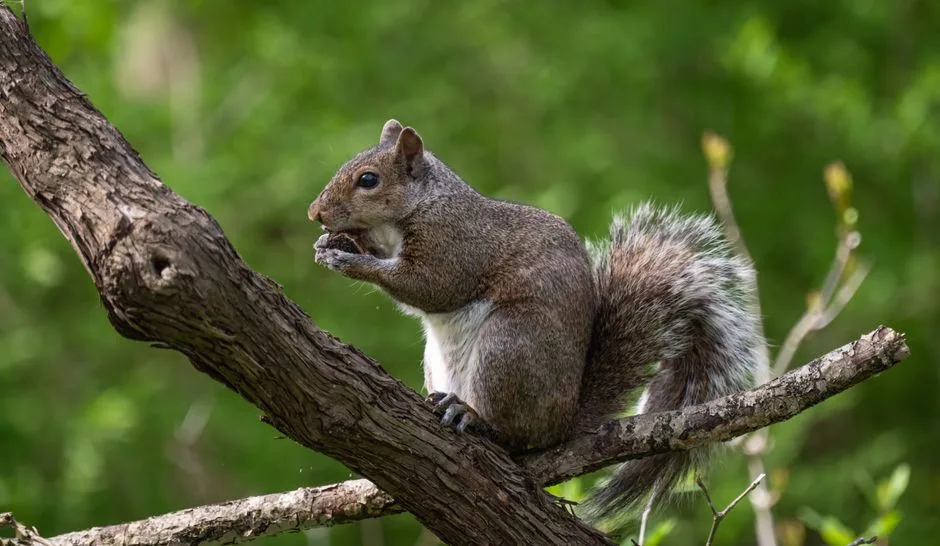
Tree squirrels, the species most common at backyard feeders, are adapted for moving through tree canopies, which means jumping across gaps is a routine part of how they get around, not a rare or desperate maneuver. Strong hind legs, a long tail for balance, and sharp claws for landing grip all work together to make a confident, accurate jumper.
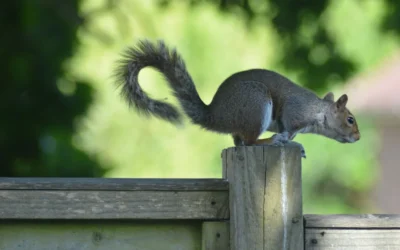
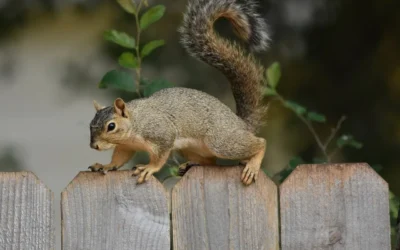
This is worth keeping in mind when planning a setup: a squirrel treating your fence rail as a launch point isn’t pushing the edge of its ability, it’s using a skill that’s completely normal for the species.
The Three Variables That Change Jump Distance
Launch Height Relative to Landing Height
A jump starting higher than it ends, like from a roofline down to a feeder, covers more distance than a level jump between two points at the same height, since gravity extends the arc. A jump starting lower than it ends, like leaping up from the ground, covers noticeably less distance than either.
Launch Point Stability
A solid, stable surface like a fence rail or thick branch lets a squirrel push off with full force. A thin, flexible branch absorbs some of that push, which shortens the effective jump even if the squirrel is otherwise capable of covering more ground.
Motivation and Familiarity
A squirrel that has fed successfully at a location before will commit to a jump more readily than one exploring a new spot for the first time. Established feeding routines tend to produce more confident, and effectively longer, jumps over time as the animal learns the layout.
So How Far Can They Actually Jump?
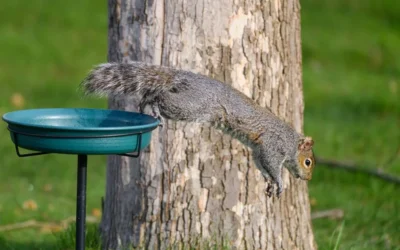
Wildlife extension resources generally describe a healthy tree squirrel’s horizontal jump, from a solid, level launch point, as covering several feet without much difficulty. On a downward jump from a higher launch point, that distance extends further, since the animal is gliding through part of the fall rather than relying purely on leg power.
There’s no single authoritative number that applies to every squirrel and every yard, and treating any figure as an exact cutoff is a mistake. The safer approach is to give more clearance than seems necessary, since the cost of extra distance is minor compared to the cost of a feeder that keeps getting raided. A few extra feet of clearance costs nothing beyond a slightly longer walk to refill the feeder, while too little clearance means starting the whole placement decision over later.
Jumping Up From the Ground
Ground-level jumps work differently than jumps between elevated points, since the squirrel is fighting gravity the entire way up rather than gliding through part of an arc. This is one reason a properly mounted baffle at an adequate height is effective even without perfect distance from every launch point, a squirrel starting from flat ground simply can’t cover the same vertical distance it manages jumping between two elevated surfaces.
This is also why baffle height and jump distance from elevated launch points are usually the two separate failure points worth checking first when a setup isn’t working. See our complete guide to squirrel baffles for how these pieces fit together in a full setup.
Seasonal Changes in Jumping Behavior
Squirrel activity around feeders isn’t constant year-round. In fall, squirrels cache food aggressively ahead of winter, and feeder visits tend to become more frequent and more determined, including more repeated jump attempts at a feeder that’s proven difficult to reach. In late spring, young squirrels leaving the nest are still learning their own limits, and may attempt jumps that a more experienced adult would judge as too far, occasionally missing entirely.
None of this changes the underlying physics of how far a jump can go, but it’s worth expecting more attempts, not fewer, during these periods rather than assuming a quiet stretch in summer means the setup is solved for good.
Why This Matters More Than Baffle Height Alone
A baffle blocks a climb up the pole from ground level. It does not block a jump that starts from a branch, fence, or roofline and lands past the baffle entirely, on the pole above it or directly on the feeder. Jump distance is the reason baffle height and placement distance from structures are two separate problems that both need solving. See our guide on safe placement distance from trees and structures for the planning side of this, and our guide on baffle height guidelines for the climbing side.
If Squirrels Are Already Jumping Past Your Baffle
Understanding jump distance is useful for planning a new setup, but if you already have a baffle installed and squirrels are getting past it, the fix usually involves identifying the specific launch point they’re using rather than relearning the general theory. Our troubleshooting guide on stopping squirrels from jumping over a baffle walks through that process step by step. Our full squirrel baffle collection and heavy-duty baffle roundup are also useful starting points if the fix ends up being a wider or taller baffle rather than a placement change.
Frequently Asked Questions
How far can a squirrel jump horizontally?
From a solid, level launch point, a healthy tree squirrel can cover several feet without much effort, according to general wildlife extension guidance. The exact distance varies by individual animal, launch point stability, and motivation, so treat any figure as a rough guide rather than a hard limit.
Can squirrels jump farther downward than across?
Yes. A downward jump from a higher launch point, such as a roofline or tall branch, covers more ground than a level jump from something like a fence rail, since gravity extends the distance the squirrel travels before landing.
Do all squirrel species jump the same distance?
No. Common backyard tree squirrels like eastern gray squirrels are strong, confident jumpers built for moving through tree canopies. Ground squirrels and chipmunks, while still agile, generally rely less on long jumps and more on climbing and running, so the distances discussed here apply mainly to tree squirrels at feeders, which are the species most backyard baffle setups are designed around.
Is there a baffle that stops jumping entirely?
No baffle can stop a jump on its own, since a baffle addresses climbing, not jumping. Adequate distance from launch points combined with a properly sized and placed baffle is what actually prevents both climbing and jumping approaches from succeeding.
Can squirrels jump from the ground straight onto a feeder?
A vertical jump from flat ground covers far less distance than a jump between two elevated points, since the squirrel has to overcome gravity for the entire jump rather than gliding through part of it. This is part of why a correctly mounted baffle at an adequate height works even in yards that can’t achieve ideal distance from every nearby structure.

Write Your Review
No reviews yet. Be the first to share your experience!