

A dedicated bird feeder pole is usually sturdier than a shepherd hook and thicker than a decorative stake, which is exactly why a baffle sized for one doesn’t always fit the other. We compared baffles and pole systems built for standard feeder poles and scored each one against the criteria on our How We Review page. Specs and public ratings below reflect our research at the time of publication and can change, check the current listing for up-to-date price and availability.
As an Amazon Associate we earn from qualifying purchases through the links below. Commissions do not affect which products we recommend or how we rank them, see our Affiliate Disclaimer for details.
Mounted on a shepherd hook or a 4×4 wood post instead? See our Best Squirrel Baffle for a Shepherd Hook or Best Squirrel Baffle for a 4×4 Post roundups, the broader Best Squirrel Baffles for Bird Feeders roundup for every setup at once, or check Squirrel Baffles: The Complete Guide for the full rundown of baffle types.
Pros
- Complete system, no need to buy a separate pole, base, and baffle
- Multi-directional spring baffle adds more unpredictability than a simple tilt or wobble
- Threaded steel construction holds steady under the weight of multiple feeders
Cons
- Highest price in this roundup by a wide margin, since it replaces your entire pole setup
- Feeders and accessories are sold separately, this is the pole system only
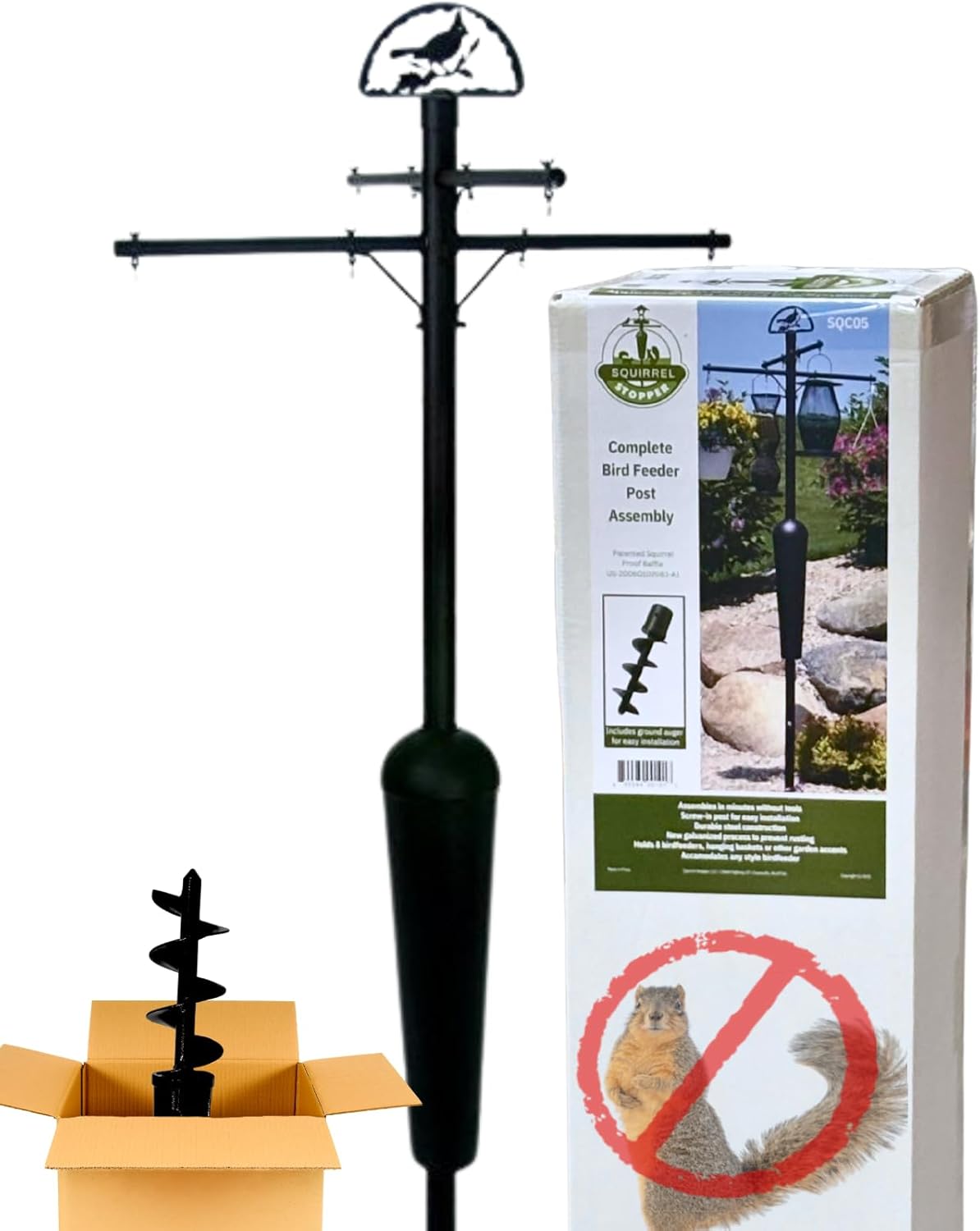
Every other pick in this roundup is a baffle meant to attach to a pole you already own. This one is a different category entirely, a complete feeding station built around a patented spring baffle, sold as pole, base, and baffle together.
The standout feature is the spring mechanism itself, which the manufacturer describes as moving up, down, and sideways under a squirrel's weight rather than tilting in one predictable direction. Combined with 2 inch galvanized steel and threaded connections at every joint, the pole itself is built to stay rigid under load rather than leaning over time.
Ground stability comes from a two-foot auger that screws into soil without tools or concrete, and the system is rated to hold up to eight feeders, planters, or accessories across its adjustable arms, useful if you run more than one or two feeders.
The tradeoff is straightforward: this costs far more than any baffle-only pick here, because you are buying an entire feeding station, not a single component. Feeders themselves are sold separately.
For a yard that wants one purpose-built system instead of retrofitting an existing pole, this is the most complete option in this roundup, at a price that reflects that completeness.
Pole material: 2 inch galvanized steel, powder-coated, threaded connections. Baffle mechanism: patented multi-directional spring. Base: two-foot ground auger, no concrete needed. Capacity: up to 8 feeders or accessories on adjustable arms. Manufacturer placement guidance: install at least 10 feet from walls, fences, or overhangs.
Choose this if you are building a dedicated feeding station from scratch and want one system rated for multiple feeders rather than assembling a pole, base, and baffle separately. If you already have a pole you're happy with, a standalone baffle from the other picks in this roundup is the better value.

Pros
- Solid, heavyweight build resists chewing well
- Wider than common 16-inch designs
- Straightforward, low-maintenance design
Cons
- Very small review sample so far, early feedback carries real uncertainty
- No active motion mechanism
This baffle prioritizes sheer material toughness, a solid 3.3 pound assembly with a 1mm metal panel, over an active motion mechanism, aimed at buyers who want maximum gnaw resistance in a straightforward, low-maintenance design.
It suits yards where chewing damage has been the main failure point on previous baffles, since the thicker metal and heavier overall build directly address that specific weakness.
The 19-inch coverage is wider than common 16-inch designs, adding some passive reach benefit on top of the gnaw resistance.
The review sample is very small so far, meaningfully smaller than the established picks in this roundup, so treat the strong early rating as a limited data point rather than a settled track record.
For buyers prioritizing raw build toughness over active motion, and comfortable with a newer, less-reviewed listing, this is worth considering.
Weight: 3.3 pounds.
Material thickness: 1mm metal panel.
Diameter: 19 inches.
Mechanism: static, no spring motion.
Worth considering if chewing damage, not climbing ability, has been your main problem with previous baffles.
If you want a longer proven track record before buying, the established picks in this roundup have far more owner feedback.
Pros
- Least expensive baffle in this roundup
- Polycarbonate material won't rust, a real advantage over metal in humid climates
- Interlocking panel design helps keep rain and snow out of the feeder below
Cons
- Polycarbonate is more prone to chewing damage over time than solid metal, even at 3mm thick
- Fits a narrower pole range (2/3 to 1-1/4 inch) than some of the metal picks here
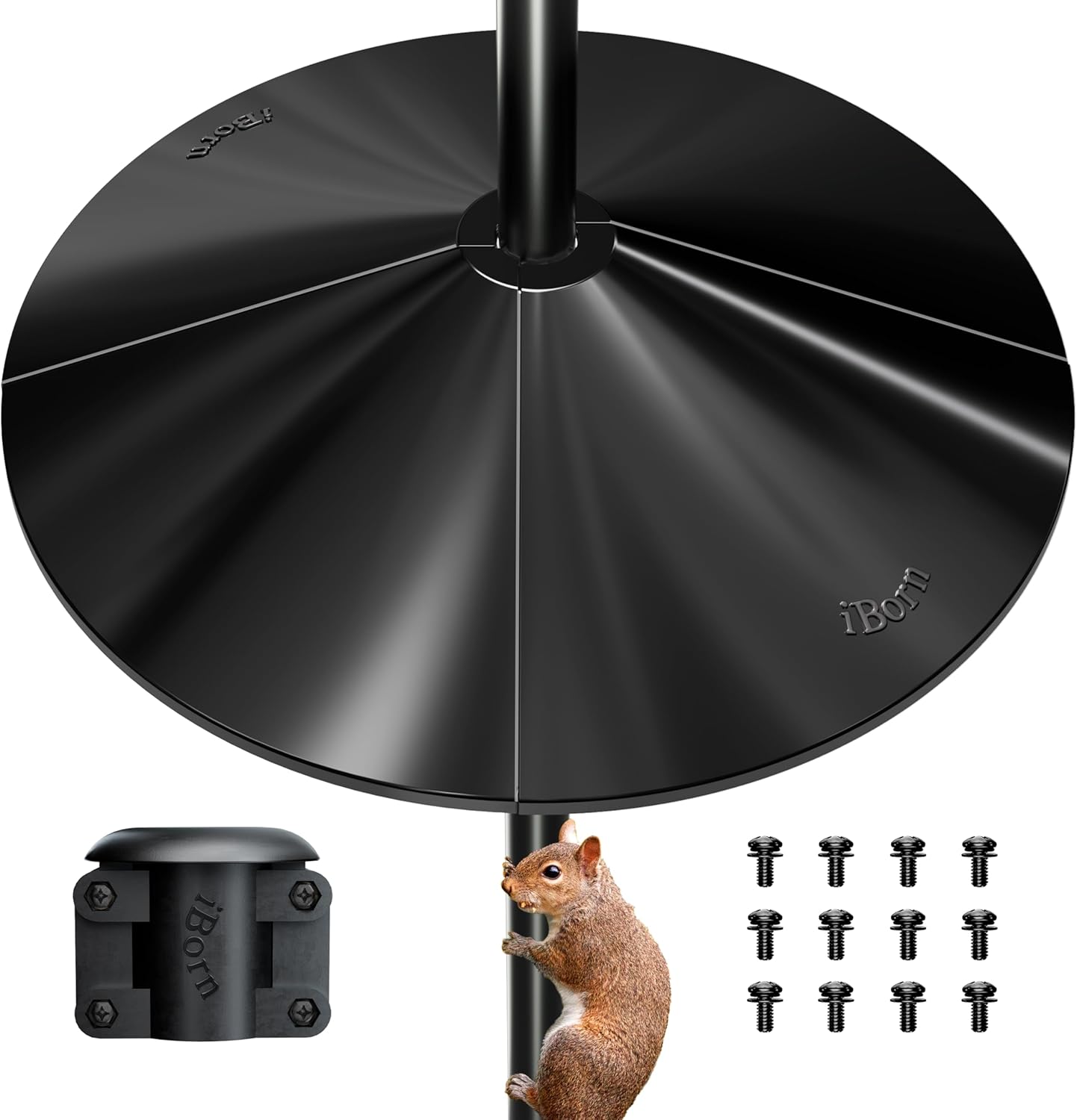
Instead of a steep, narrow cone, this baffle takes a wide-collar approach, an oversized 19.6-inch diameter meant to keep a squirrel's reach short even if it manages to climb the pole below it.
The standout feature is the material: 3mm thick polycarbonate rather than metal, which the manufacturer positions as more rust-resistant in humid or rainy climates while still resisting chewing better than thin plastic.
Build quality relies on a 4-panel interlocking design, male and female panels that snap together around the pole, which also helps block rain and snow from seeping down into the feeder below.
The listing includes specific placement guidance: mount 5 to 6 feet above the ground, hang the feeder about 2 feet above the baffle, and keep at least 2 feet from walls, fences, or trees, useful starting numbers regardless of which baffle you choose.
The tradeoff is durability under sustained chewing pressure. Polycarbonate holds up better than basic plastic, but it isn't as chew-resistant as the solid metal picks in this roundup over many seasons.
Diameter: 19.6 inches. Material: 3mm thick polycarbonate (PC), 4-panel interlocking design. Mount range: 2/3 to 1-1/4 inch pole diameter. Manufacturer placement guidance: mount 5 to 6 feet above ground, feeder 2 feet above baffle, 2 feet minimum from structures.
A reasonable starting baffle if budget matters most and your climate is humid or rainy, where rust resistance outweighs the slightly lower chew resistance compared to metal. In yards with heavy, repeated squirrel pressure, a metal pick from this roundup will likely hold up longer.

Pros
- Two motion types in one mechanism
- Heavy-duty steel resists chewing
- More affordable than full pole systems
Cons
- Smaller review sample than established brands
- Combined motion adds complexity versus a single-motion design
Rather than relying on one motion type, this baffle combines wobble and spin in a single integrated spring mechanism, aimed at squirrels persistent enough to adapt to a single, predictable motion.
It suits buyers who have already tried a simpler passive baffle and want a genuinely different mechanism rather than just a bigger version of the same static design.
Steel construction handles the gnawing that plastic baffles eventually succumb to, and the design is rated for year-round outdoor exposure.
The review sample is smaller than the most established pick here, though the core mechanism, combining two motion types, is a genuinely distinct approach worth considering on its merits.
For squirrels that have shown they can adapt to a single type of movement, the combined wobble-and-spin approach here offers something different to overcome.
Diameter: 18 inches.
Motion: combined wobble and spin.
Material: heavy-duty steel.
Mount type: round pole.
Worth trying if a single-motion baffle, wobble-only or spin-only, hasn't fully solved your squirrel problem.
A reasonable mid-price option between the budget picks and the premium complete system here.

Pros
- Clear material is far less visually obtrusive than black or green baffles
- Serrated edge adds a texture-based deterrent on top of the wobble motion
- Adjustable buckle mount lets you fine-tune mounting height without extra hardware
Cons
- Fits round poles only, from 1/2 to 1 inch, not square posts or wider poles
- Clear plastic shows dirt and water spots more visibly than opaque materials over time
Most baffles are designed to be functional first and visually secondary, usually black or green. This one leads with a clear polycarbonate build that blends into the pole rather than standing out in the yard.
The standout feature is the serrated edge, an added texture around the rim intended to make it harder for a squirrel to get a grip, layered on top of the wobble motion from the buckle mount.
Build quality centers on 0.32-inch thick polycarbonate with a metal fixing buckle, avoiding the all-plastic hardware some clear baffles use at weaker points like the mounting collar.
The buckle mount also allows adjustable height, useful if you want to fine-tune placement without buying separate spacers or hardware.
The tradeoff is fit range and appearance upkeep: it's sized for round poles from 1/2 to 1 inch only, and clear plastic tends to show water spots and dirt more visibly than an opaque finish over time.
Diameter: 19 inches. Material: 0.32-inch thick polycarbonate, clear, metal fixing buckle. Mount range: 1/2 to 1 inch round poles only. Mount style: adjustable-height buckle, serrated edge.
A good fit if you want a baffle that doesn't visually dominate the pole, and your pole is a standard round 1/2 to 1 inch diameter. If chew resistance matters more than appearance, a solid metal pick in this roundup is the more durable long-term choice.
Best Premium: Squirrel Stopper Deluxe Complete Pole System
This is not just a baffle, it’s a full heavy-duty pole system with a patented spring baffle built in, an auger base, and room for up to eight feeders and accessories. It carries the highest public rating in this roundup, at a price that reflects the complete setup.
Who shouldn’t buy it: anyone who already has a pole they like and just wants to add a baffle, this is priced and built as a full replacement system for a dedicated feeding station, not an add-on.
Best Value: eWonLife 19-Inch Metal Baffle
A metal baffle built around a stainless steel wobble spring and a baked-on powder coating, priced well below the premium pick above while still holding a strong public rating.
Who shouldn’t buy it: anyone who wants the lightest possible baffle for a thin, less sturdy pole, the solid metal build adds weight the polycarbonate picks in this roundup don’t have.
Best Budget: iBorn 19.6-Inch Polycarbonate Baffle
An oversized polycarbonate baffle priced below the metal picks in this roundup, using a wide wobbling collar design that wraps around the pole instead of a rigid cone.
Who shouldn’t buy it: yards with heavy, persistent squirrel chewing pressure, polycarbonate resists damage better than thin plastic but still isn’t as chew-proof as solid metal over many seasons.
Best Anti-Climb Design: 18-Inch Spring Wobble and Spin Baffle
A heavy-duty steel baffle whose spring mechanism doesn’t just tilt, it wobbles and spins when a squirrel tries to climb or jump onto it, adding motion in more directions than a simple tilting spring.
Who shouldn’t buy it: anyone with a pole thicker than 1.2 inches or a square 4×4 post, this clamping system is sized for standard round feeder poles only.
Best Clear: Polycarbonate Baffle With Serrated Edge
A clear polycarbonate baffle that blends in visually rather than standing out, combining a serrated edge with a wobbling buckle mount and an adjustable installation height.
Who shouldn’t buy it: anyone who wants the most chew-resistant material available, polycarbonate holds up well but a solid metal pick in this roundup will outlast it under sustained chewing pressure.
How to Choose a Baffle for a Bird Feeder Pole
The five picks above range from a complete pole system to simple add-on baffles. Use the criteria below to figure out which category fits your setup.
Match the Baffle to Your Pole’s Actual Diameter
Dedicated feeder poles typically run thicker than a shepherd hook but thinner than a 4×4 post, often somewhere in the 0.5 to 1.5 inch range depending on the pole. Measure your pole’s actual diameter with a tape measure rather than assuming it matches a “standard” size, since that range varies by manufacturer.
Complete System vs Add-On Baffle
If you’re setting up a new feeding station from scratch, a complete pole-and-baffle system built as one unit can be worth the higher price, especially if you plan to hang more than one or two feeders. If you already have a pole installed and just want to stop squirrels from climbing it, a standalone add-on baffle is the more budget-friendly route.
Passive Cone vs Active Spring or Wobble Defense
A passive baffle relies purely on its diameter and slope to block climbing. A spring or wobble-mounted baffle adds movement on top of that, and some go further with multi-directional spring or spin action rather than a simple side-to-side tilt. If squirrels in your yard have already beaten a passive baffle, an active mechanism is worth the step up.
Placement and Ground Stability
A heavier pole system depends on a stable base as much as a good baffle, some use a ground auger instead of a simple push-in spike for exactly this reason. Whatever pole you use, keep it far enough from trees, fences, and rooflines that a squirrel can’t jump past the baffle entirely, see the placement section of our Complete Guide for the distances we recommend.
Final Thoughts
If you’re building a dedicated feeding station and want one complete, heavy-duty system, the Squirrel Stopper Deluxe Pole System is the most thorough option here, with a multi-directional spring baffle and room for up to eight feeders. If you already have a pole and just need a reliable baffle to add to it, the eWonLife Metal Baffle offers solid metal construction and a real wobble spring at a fraction of the price. Either way, measure your pole and check its weight rating before you order.
Frequently Asked Questions
What’s the difference between a bird feeder pole and a shepherd hook?
A shepherd hook is typically a thin, curved decorative stake, while a dedicated bird feeder pole is usually a straighter, sturdier post built specifically to support one or more feeders. Feeder poles often run slightly thicker in diameter and can support more weight, which matters if you plan to hang multiple feeders from the same mount.
How many feeders can one pole system safely hold?
It depends entirely on the pole and base, not the baffle. A standalone baffle doesn’t add carrying capacity, so check the manufacturer’s weight rating for your specific pole and base before hanging more than one or two feeders, especially heavier ones like suet cages.
Does a heavier pole system need a deeper base than a baffle-only setup?
Generally yes. A pole carrying multiple feeders puts more lateral force on its base, so a system rated for higher capacity usually specifies a deeper anchor, like a ground auger, rather than a shallow push-in spike. Follow the manufacturer’s installation depth rather than reusing the same shallow hole you’d use for a single lightweight feeder.
Can I add a baffle to a pole I already own, or do I need a complete system?
Most of the picks in this roundup are standalone baffles that clamp or slide onto a pole you already have, no replacement needed. A complete system with the pole and baffle built together, like our premium pick above, only makes sense if you’re starting a new feeding station or want more hanging capacity than your current pole offers. Our installation guide covers mounting a baffle on an existing pole step by step.
Do wobble baffles work as well on heavy complete pole systems as on lightweight add-on baffles?
Generally yes, though the wobble motion tends to be more pronounced on a lighter add-on baffle than on a heavy complete system, simply because there’s more mass to move. A heavier system leans more on its wider diameter and stable base to block climbing, with the wobble acting as a secondary layer rather than the primary defense the way it is on a lighter pole.






Write Your Review
No reviews yet. Be the first to share your experience!